Flow
Mission orchestration that plans the safest, quietest and most efficient route in real time.
- Dynamic route planning
- Weather & risk awareness
- Fleet-agnostic API
Simplycity is the trusted coordination layer for autonomous drones in European cities — transforming urgent, low-emission logistics from a regulatory maze into a quiet public utility.
Not a drone manufacturer.
Not another delivery app.
Our longer-term vision: the civic operating system that lets drones earn a place in the city.
Simplycity connects operators, public authorities, landing infrastructure and customers in a shared, auditable flight environment.
Mission orchestration that plans the safest, quietest and most efficient route in real time.
A shared operational picture for every stakeholder, from city desk to first responder.
Measure the benefit of every mission and prove that air logistics improves city life.
Flow, Trust and Impact running end to end against a simulated SC-17: a clinician requests a transfer, twelve release gates check live data, a named operator signs the release, the aircraft flies the corridor, custody transfers and every decision lands in a tamper-evident ledger.
12 release gates · 4 scripted scenarios, 3 of them failure cases · 90 API routes · automated safety, security & custody test coverage
Sign in by role or let the platform run a full mission, a refused release, a storm-forced return and a lost link — live.
OPEN THE PLATFORM ↗ 02What residents can see: routes, service, noise with method, and a way to respond. No live positions published.
OPEN PUBLIC PAGE ↗ 03The data an aircraft or operator provides, rendered from the running API. The simulator uses the same endpoint.
READ THE CONTRACT ↗ 04What has to be true for the business to work: editable fees and costs, Simplycity revenue only.
OPEN THE MODEL ↗Sandbox: simulated aircraft, illustrative organisations and clearly flagged synthetic history. Nothing here is an operational approval. Read the PoC guide · 10-minute demo script
Our first service is intentionally unglamorous: moving time-critical medical samples between hospitals and laboratories across the Amsterdam region.
This is the wedge: repeatable routes, essential outcomes, controlled operations — and a service patients never need to think about.
See the pilot model ↓*Initial planning hypothesis to validate during pilot design; outcomes depend on route, weather and ground handling.
The healthcare sponsor pays setup, integration and per-mission fees for a first funded pilot corridor.
Care networks and operators license the coordination and assurance layer per corridor. The base case assumes the city pays nothing; governance reporting is upside.
Our intended moat: operational integrations, regulatory workflows and corridor data that build up with every authorised route. It is a hypothesis for now, not a proven moat.
Secure an anchor care partner, operating partner and municipal working group.
Run supervised demonstrations, complete risk assessment and community sessions.
Launch a limited medical corridor with measured service, safety and noise data.
Convert pilot learnings into a repeatable Simplycity city-launch playbook.
Safety No unacceptable safety events, measured against the operator’s authorised safety case; every exception recorded and reviewed
Service ≥95% missions within agreed window
Acceptance ≥70% positive among residents sampled in the corridor impact area, surveyed before and after operations
Economics Validated price per movement and a cost-to-scale model per route
We are assembling a small founding coalition to design and launch the Amsterdam care-corridor pilot in the next 30 days.
Indicative fundraising narrative — subject to legal, operational and regulatory diligence.
Start a conversation →CAREWING is a supplier-neutral reference configuration for the first medical corridor — not a Simplycity product. It defines the aircraft envelope partners should meet: vertical rooftop access, 2.5 kg clinical payload and efficient wing-borne flight.
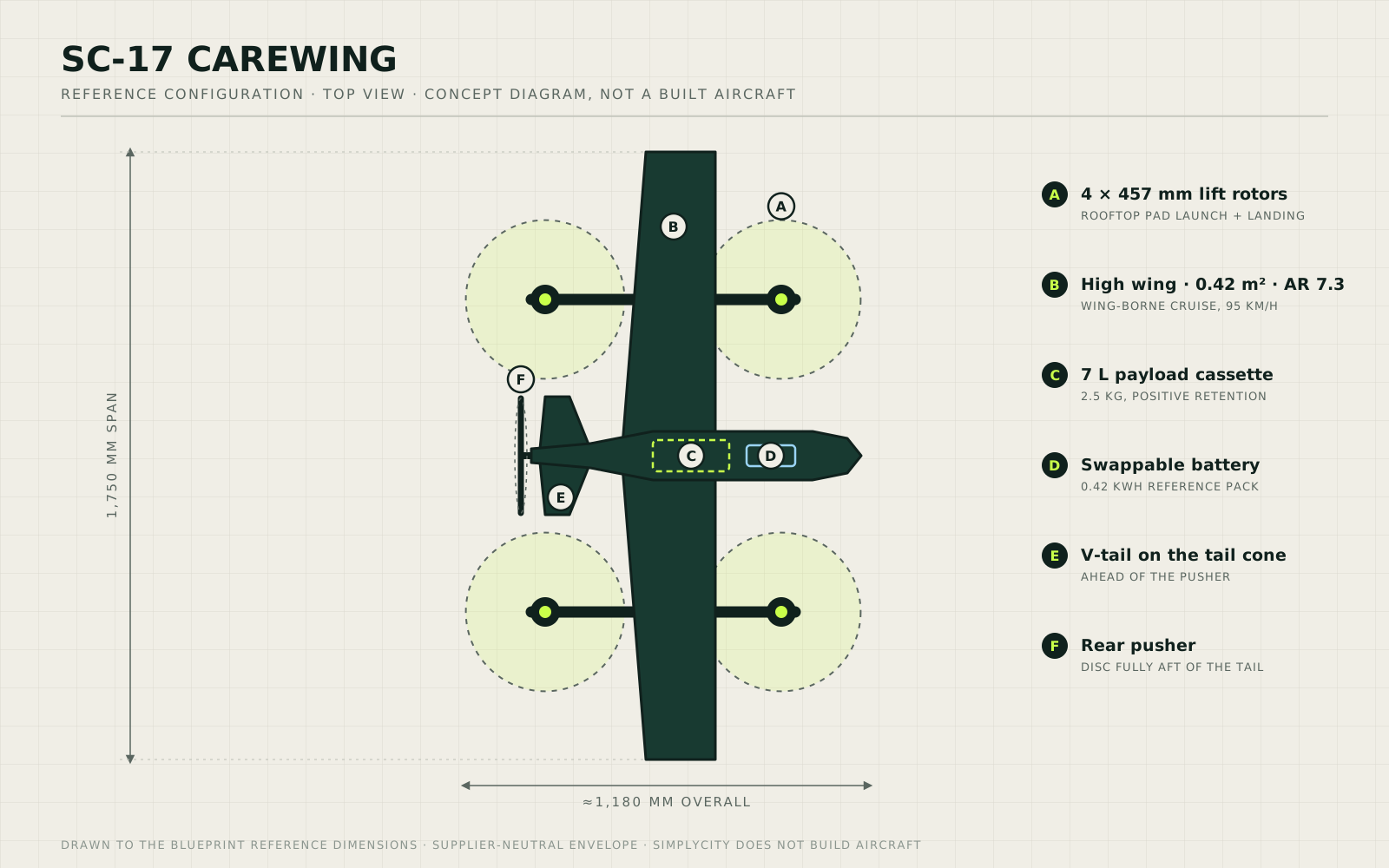
Four lift rotors handle the pad. A high wing and rear pusher make the corridor leg more energy-efficient than continuous hover. OEMs, not Simplycity, build and operate the aircraft.
Download the preliminary design package, view the renders and use the OEM-neutral requirements brief to assess real aircraft candidates. These materials are concept work — not flight or manufacturing approval.
The project in 15 slides: the opportunity, role boundary, Flow/Trust/Impact, the 17-minute care corridor, the SC-17 reference aircraft and the 12-month plan.
VIEW PDF ↗ · .pptx ↓Who pays whom, customer and corridor economics, regulatory path, validation plan and the €750k raise — plus the long-form investor brief.
DECK PDF ↗ · .pptx ↓ · BRIEF PDF ↗ · .md ↓Portable PDF: mission, calculations, safety gates and handoff context.
VIEW PDF ↗ · .md ↓Living blueprint for workflows, architecture, integrations and build phases. v0.2 with PoC status.
VIEW PDF ↗ · .md ↓Revenue streams, responsibility boundary and why SC-17 is a reference, not a product.
VIEW PDF ↗ · .md ↓Supplier-neutral technical and integration requirements for the pilot.
VIEW PDF ↗ · .md ↓What the working sandbox implements, how to run it, security posture, tests and limits.
VIEW PDF ↗ · .md ↓Ten-minute walk-through for partners and investors, with the hard questions and honest answers.
VIEW PDF ↗ · .md ↓New to the project? One mission followed through all seven roles, step by step — what each person does and why it matters.
VIEW PDF ↗ · .md ↓For aircraft manufacturers: every live endpoint, auth, exact field ranges and how each one feeds a real release gate. Send this to a vendor as-is.
VIEW PDF ↗ · .md ↓Directory: /resources/deliverables · Live: platform, community page, API contract, unit economics — including renders, editable documents and the full calculation source.